「アイヌ文化」を対象とした民族展示の調査
研究全体の概要 本研究は、民族文化の表象をめぐる問題を考察していくために、博物館展示のあり方を比較しようとするものである。本調査では、日本の先住民族であるアイヌに着目し、その中心的居住地である北海道の博物館・資料館の展示を対象として「アイ…


Photo 1. Women pounding pearl millets (Pennisetum glaucum, known as “Omahangu” locally) for decortication outside home, in Goreangab informal settlement, Windhoek
Due to Apartheid regime and contract labor system in the colonial times, migrants from North-Central Namibia were mainly males. After independence, with such restrictions being removed, females are leaving their rural homes, migrating to Windhoek for employment or education opportunities [Frayne 2007]. Most of them have settled at informal settlements to the north of Windhoek. Among them, unmarried mothers or female-headed households, as the most financially struggling group [Mbongo 2017], are more susceptible to food insecurity. As migration surges, Aawambo, the largest ethnic group from North-Central Namibia, likely accounts for the largest number in Windhoek’s informal settlements, though official statistics do not reveal the exact population. Because of matrilineal descent system (through which social support from matrilineal kin is often highly visible), and gender roles expected of women [Haugh, 2022], unmarried Aawambo mothers play a vital role in provisioning, rationing and decision-making in the sphere of food at household level.
Previous studies done by researchers such as Frayne, Crush [2019] et al document urban food insecurity in Windhoek’s informal settlements, highlighting rural-urban food transfers (hereafter referred as RUFT) as a key coping strategy. Additionally, Guettou and Djurfeldt [2014] focused on urban Aawambo and gendered food transfers in Windhoek, arguing that RUFT “can be seen as social capital in the livelihoods framework”, which connects rural and urban kins as a social tie. However, existing literature overlooked nuanced, internal variations of female-headed households at informal settlements and how they impact food resources. The study tries to explore such variations, by looking at household formation and food related activities at more granular level, and to capture social dynamics among urban household members and between rural and urban kins, to examine how the status/positionality of unmarried mothers are instrumentalized to seek food resources and secure food access.

Photo 2. Mother interacting with her newborn caringly, by a table with sorghum-based beer atop, in Okuryangava informal settlement, Windhoek
During the nearly 2-month long fieldwork, I conducted semi-structured interviews and multiple informal conversations, along with participant observation on existing informants (n=6) and identified new informants (n=3) in informal settlements of Goreangab, Havana, Okuryangava and Okahandja Park located in constituencies of Samora Machel, Moses ||Garoëb and Tobias Hainyeko in Windhoek (as indicated in Map 1). Moreover, life histories and kinship chart are recorded to understand their migration routes and changing household structures which might greatly impact their food access, meal patterns and food-related behaviors. I asked one informant to record foods consumed in the form of written text dated from 17/07 till 18/08/2025. Regular follow-ups were implemented to ensure data accuracy and completeness.
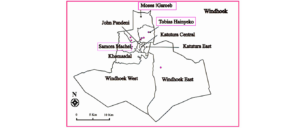
Map 1: Research Site
Source: Administrive Map Sourced from 2023 Population & Housing Census Report
With increasing exposure to and availability of animal protein, the diet by most research participants is gradually shifting from traditional plant-based in rural homes to mainly protein-based in urban settlements. More work needs to be done in informal markets to understand market formation, driving factors for such consumptions and people’s perception of such foods.
Crush, J., Nickanor, N., & Kazembe, L. 2019. Informal Food Deserts and Household Food Insecurity in Windhoek, Namibia. Sustainability, 11(1), 37. https://doi.org/10.3390/su11010037
Frayne, B. 2007. Migration and the changing social economy of Windhoek, Namibia. Development Southern Africa, 24(1), 91–108. <https://doi.org/10.1080/03768350601165918>
Guettou, N., Djurfeldt, A. 2014. Gender and Access to Food: A Case Study on Gender Differences in Access to Food through Rural to Urban Food Transfers, and its Impact on Food Security in Moses //Garoëb, Windhoek, Namibia. MSc Thesis. http://lup.lub.lu.se/student-papers/record/4588681
Haugh, W. A. 2022. Culture Summary: Ovambo. Human Relations Area Files. https://ehrafworldcultures.yale.edu/document?id=fx08-000
Mbongo, L.T 2017. Food Insecurity and Quality of Life in Informal Settlements of Katutura, Windhoek, Namibia. <https://repository.unam.edu.na/bitstream/handle/11070/2326/mbongo_2017.pdf?sequ ence=1&isAllowed=y>
Copyright © 附属次世代型アジア・アフリカ教育研究センター All Rights Reserved.